

Before the first freeze: the one-hour September heat check small landlords keep skipping

Before the first freeze: the one-hour September heat check small landlords keep skipping
Furnaces rarely quit politely. They wait for the coldest week and the busiest contractor season. This is the one-hour September walkthrough that moves the failure into a mild morning where an hour and a ten-dollar filter are enough.
The phone rings at 9:40 on a Wednesday night in late November. The caller is the tenant in unit two, and her voice has that flat, tired quality that means she has already been sitting in her coat for an hour. The heat blows cold. The furnace is off. Outside it is 26 degrees and dropping.
You know what happens next, because you have lived through it before. You call every HVAC number you have saved. Half go to voicemail. The ones that answer quote you an emergency visit and an earliest arrival of Thursday afternoon, because every furnace in the county quit on the same three nights this week. Tenant comfort, your sleep, and your bank account all take a hit, and the repair itself might have been a ten dollar part.
None of that is really a November problem. It is a September problem that nobody scheduled.
Why September wins the winter
Furnaces fail hardest the first week cold weather arrives, when systems that coasted all year suddenly have to run for real, and when every landlord in your metro is calling the same contractors. HVAC shops are calm in September. A tech who checks your furnace mid-month can stand around it, run it through a full cycle, and fix a small thing before the freeze forecast turns it into a midnight emergency.
The national guidance says the same thing in calmer words. ENERGY STAR's heating and cooling maintenance checklist recommends having your heating system serviced in the fall, before the season starts, and suggests tying the reminder to the daylight saving time change so it is hard to forget. They also point out that a well-tuned system quietly saves money, which matters on an older rental where space heating is the single biggest energy expense in the house.
The one-hour owner walkthrough
Here is the honest version of what you can safely do yourself in an hour, per unit. This is inspection and simple upkeep, not repair. Anything that opens a panel, touches gas, or involves wiring belongs to a licensed technician.
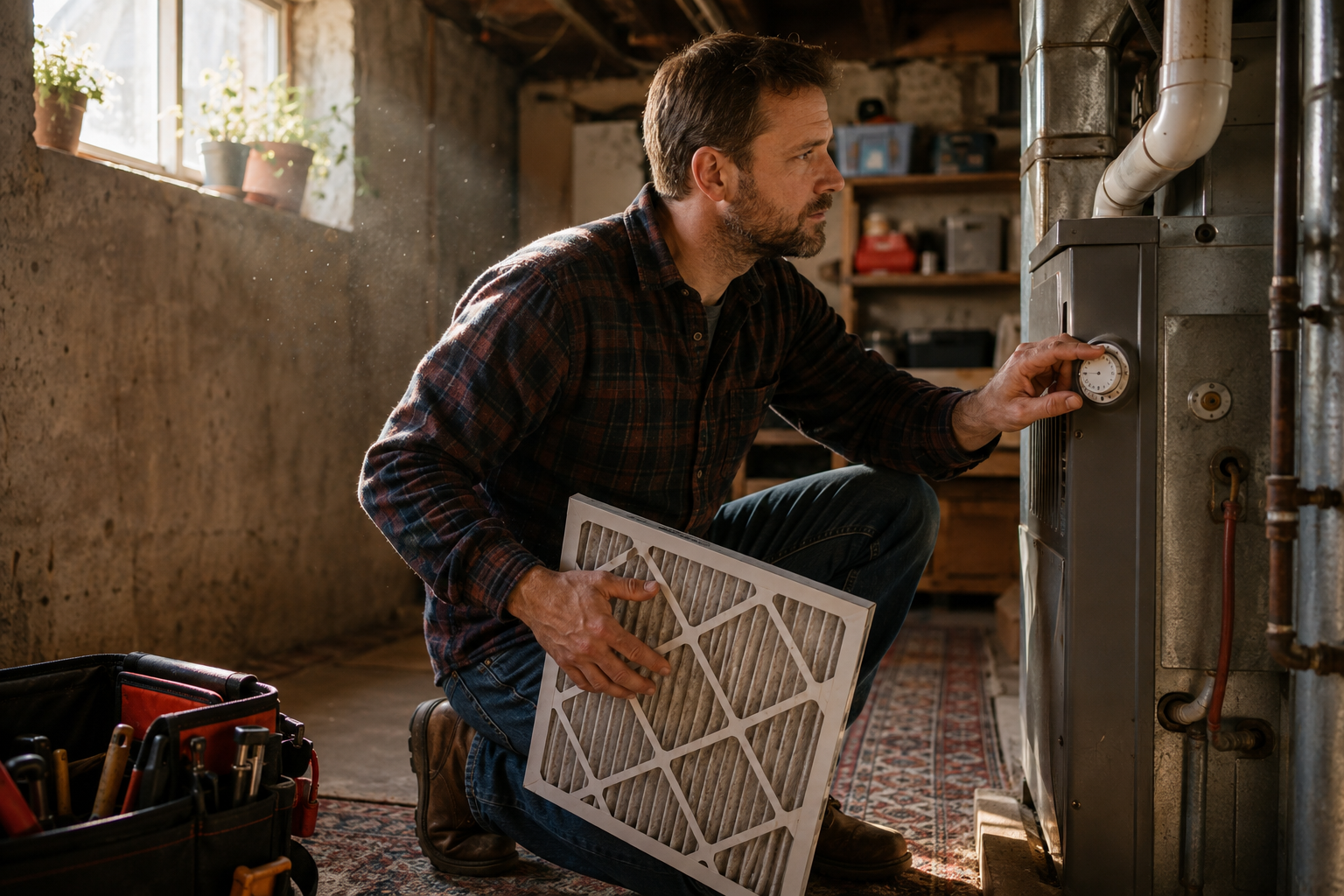
Start with the filter. Pull it out and hold it up to a light. If you can't see through the fabric, it is done for the year. Before you drop in the new one, look at the numbers printed on the old filter's frame, because the size matters and so does direction: most frames have an arrow showing which way the air flows. A filter installed backwards loads itself with dust in days. Write the size on the inside of the furnace panel door with a marker so next year's you stops hunting.
Next, walk the vents and returns in each unit. Clear away shoes, boxes, rugs and pet beds that have drifted in front of them over the summer. A blocked return is one of those invisible problems that makes a furnace short-cycle and stresses itself to death over a winter.
Then run a test fire. Turn the thermostat up two degrees on a cool morning and stand near the unit while the cycle starts. You are listening for three things: a hard bang or rumble when the burner lights, a persistent rattle that travels through the ducts, and any smell that lasts more than a few minutes. A dusty burn-off odor the first time the heat runs all season is normal and fades within a short cycle. A sharp electrical or burning-plastic smell is not; that one means shut it down and call the pro.
Check the alarms while you are in the basement
Combustion appliances produce carbon monoxide, an odorless gas that turns a slow crack in a heat exchanger from a repair bill into a hospital story. So while the furnace is running its test cycle, press the test button on every smoke and CO alarm in the unit. Replace batteries that are more than six months old, and replace any alarm older than ten years, which is printed on the back. If a CO alarm has been chirping low-battery all summer, take the chirp seriously instead of putting a pillow near it.
What the technician actually does for your money
A service visit is not a guy glancing at your furnace and nodding. According to ENERGY STAR's checklist, a professional heating tune-up covers the parts an owner cannot reach safely: checking and correcting electrical connections, inspecting the burner assembly, examining the heat exchanger for cracks, verifying safety controls, checking gas or oil connections, and making sure condensate drains are clear. The heat exchanger is the big one. It is the wall that keeps combustion gas inside the flame path and breathable air outside. When it cracks, that wall fails quietly, and no homeowner should be hunting for that crack without training and a mirror-light.
Book the visit in September and most shops still have calendar room. Wait until the first freeze and you are on a waitlist behind everyone's emergency.
Give the tenants a nudge, not a surprise
Send a short note the week before you test the heat. Tell them the system will run a test cycle, remind them not to block vents with new fall furniture, and ask them to mention any weird noise or smell now instead of in January. Tenants who hear from you before the season are the same tenants who report the faint rattle in week two rather than calling at midnight in week twelve. One honest sentence in an email saves the midnight call.
What September looks like on paper
If you only remember the shape of the month, here it is:
- Replace or clean filters, matching size and airflow direction, and write the size on the panel door.
- Clear vents and returns of everything summer dumped in front of them.
- Run a full test cycle and listen for bangs and rattles; smell for anything beyond the first dusty burn-off.
- Test every smoke and CO alarm; swap young batteries and retire anything past ten years.
- Book the professional service visit now, while the calendar still has room.
- Send tenants a two-line heads-up and ask them to report odd sounds early.
That list fits in one evening per unit if you batch it, and the only paid item on it is the visit you were going to book eventually anyway.
Keeping those dates straight across more than a couple of units is where memory starts failing. The rule that survives contact with real life is simple: log each seasonal task the day it happens, with the filter size and the next service date attached, so next September's list writes itself from last year's notes. If you want software built for exactly that kind of log, you can download PropertySea and track service dates, units, and tenant notes in one place instead of a sticky note on the furnace.
The furnace does not care that it is inconvenient for you. It fails on its own schedule, which is almost always the coldest week of the year unless you move the problem into a mild September morning when you have an hour, a fresh filter, and a quiet basement. Do the walkthrough this month. Then forget about heat until someone else's phone rings at 9:40 on a Wednesday night.
Direct URL: https://propertysea.app/download

The Millionairess Mentality: A Professional Woman's Guide to Building Wealth Through Real Estate
These are our handpicked books to help you level up in Real Estate.
View on Amazon
💡 How To Get Tenants To *Happily* Pay for Property Upgrades!
Want nicer properties without paying out of pocket? Here's how to structure deals where tenants cover the upgrades, and love it!
Read More
A Rental Showing Day Plan for an Occupied Home
A showing request lands while someone still lives in the unit. A clear plan for timing, access, and follow-up can make the visit easier to coordinate without leaving the current resident guessing.
Read More